Why does thermal analysis matter, and who does it?
Heat removal through PCB substrates, heat sinks and fans is what keeps a high-power device performing and stops it failing. The analysis is typically run by mechanical engineers or specialist third parties simulating heat and airflow, which means it depends on data coming from the electrical side.
Thermal analysis is a crucial aspect of designing reliable electronic systems, especially for high-power devices. Effective heat removal mechanisms, such as PCB substrates, heat sinks, and fans, are essential to maintain performance and prevent failure. This analysis is typically performed by mechanical engineers or specialized third-party companies that simulate heat and airflow. Accurate thermal analysis requires detailed information about component placement on the PCB, actual power dissipation, and the materials and geometry of the PCB.
Why do accurate power ratings matter so much?
Because thermal analysts traditionally use the absolute maximum power ratings from the datasheet, and actual power consumption is often far lower — so the heat removal gets designed for a load the board never sees, at a cost it did not need to pay.
Traditionally, thermal analysts conduct calculations using the absolute maximum power ratings from component datasheets. However, the actual power consumed is often significantly lower than these maximum ratings. This discrepancy can lead to the overdesign of heat removal mechanisms, resulting in unnecessary costs and inefficiencies.
How do you get the actual stress values?
Circuit stress simulation calculates and documents the real power, current and voltage in each component, rather than inheriting the datasheet maximum.
BQR offers advanced software and professional services for component stress analysis through circuit stress simulation. Our solutions empower engineers to achieve precise calculations and documentation of actual stress values (power, current, and voltage) in electronic components.
What are the key features?
- Semi-Automatic Assignments: Stresses can be easily assigned to components using the BQR E-CAD plug-in on the schematic.
- Automated Stress Simulation: Component stress is calculated using our unique CircuitHawk simulator.
What do you gain from stress analysis?
- Early Detection of Design Errors: Identify and resolve potential issues before layout.
- Optimal Thermal Design: Exact stress calculations save space and reduce costs.
- Improved MTBF Calculations: Using precise stress data yields higher MTBF (Mean Time Between Failures) values.
What does this look like on real boards?
How much difference can accurate power dissipation make?
For IC U2a, the absolute maximum rating of 6.12 W gave a junction temperature of 137.1 °C and led the mechanical engineer to plan for an added fan. The actual simulated dissipation put Tj at 95 °C — natural cooling was sufficient, and the fan was not needed.
For IC U2a, a junction temperature (Tj) of 137.1°C was calculated based on the absolute maximum power rating of 6.12W. This result led the mechanical engineer to plan for additional cooling, such as adding a fan. However, after using the actual power dissipation data from the CircuitHawk™ simulation (see IC U2 in Fig. 1), Tj was found to be 95°C, indicating that natural cooling was sufficient. Additionally, the failure rate decreased from 6.129 to 0.804 failures per million hours, showing a reduction by a factor of 7.6.

How much does the stress assumption change MTBF?
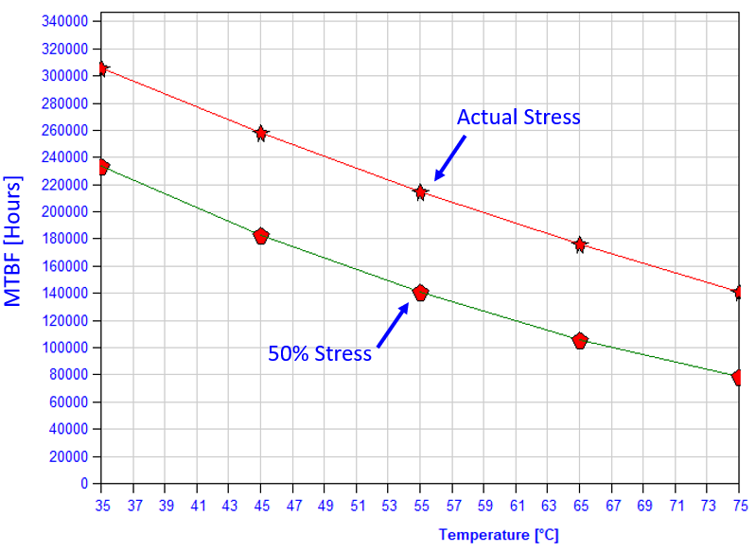
On a real board, MTBF calculated from actual stress came out roughly 1.5 times higher than the same board calculated with the 50% stress assumption.
The MTBF of an actual board was calculated using both the Parts Stress Method and the Parts Count Method. The MTBF calculated with actual stress was found to be approximately 1.5 times higher than that calculated using the 50% stress method.
What is the net effect of using actual dissipation data?
It removes cooling hardware the design never needed and raises the predicted MTBF at the same time — the cost and the reliability both move in the right direction.
Utilizing actual power dissipation data significantly reduces the unnecessary use of costly cooling elements and results in a much higher MTBF.
BQR's software solutions help engineers optimize thermal design, improve reliability, and reduce costs. Contact us for more information on our services.