Why do reliability and maintenance have to be designed together?
Because availability depends on both, and they sit in different disciplines: component reliability belongs to the reliability engineer while downtime belongs to maintenance and operations — so neither owns the number that actually matters.
Asset availability depends on the sub-systems’ reliability and down-time due to failures. The problem is that system reliability and down-time belong to different disciplines: component reliability is under the responsibility of the reliability engineer. In contrast, down-time is an issue addressed by maintenance and operations engineers.
A striking example of the interconnection between reliability and maintenance is the choice between designing a system with standby redundancy and replacing the redundancy with a spare parts maintenance policy. The similarities and differences between the two approaches will be explored in this paper regarding availability and cost.
What does the trade-off look like on a single pump?
An oil pump with an MTBF of 3 years (26,280 hours) and a mean time to repair of one week (168 hours) is 99.365% available — unavailable an average of 2.3 days a year. From there you can either add a standby pump or hold a spare.
We begin with a simple example: Consider an oil pump with a mean time between failure (MTBF) of 3 years (26,280 hours). When the pump fails the mean time to repair (MTTR) is one week (168 hours). The pump availability is therefore: 99.365%. This means that the pump is unavailable on an average of 2.3 days each year. To improve the situation one can either design the system with a second pump on standby or put a second pump as a spare part nearby.
How does the standby arrangement behave?
The backup sits idle in cold standby and takes over the moment the operating pump fails, while the failed pump goes for hot repair; the system only fails if the backup fails before that repair completes.
Initially the main pump works but the backup pump is not working (cold standby). When the operating pump fails the backup pump immediately replaces it. The failed pump is sent to the repair shop (hot repair). If the repair process finishes before the backup pump fails, the system goes back to the initial state, otherwise, a system failure occurs until one of the pumps is repaired.
The scenario described above can be modeled as a renewal process for which a simple Markov chain diagram is given in Figure 1:
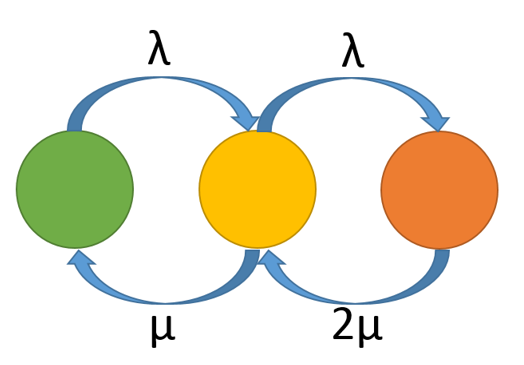
λ is the pump failure rate and μ is the single pump repair rate. In many cases (including the example above) λ / μ <<1 therefore the renewal process can be approximated by a Poisson process for which the steady state availability is:
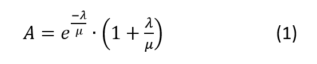
For the values presented above, the availability is 99.998% (mean annual downtime of 10.5 minutes), a significant improvement.
How does the single-spare arrangement differ?
The failed pump is immediately replaced by the spare from storage and sent for repair, and again the system only fails if the spare fails before the repair finishes.
When the pump in the field fails, it is immediately replaced by the spare pump. The failed pump is sent to the repair shop. If the repair process finishes before the spare pump fails, the system goes back to the initial state, otherwise, a system failure occurs until one of the pumps is repaired.
If the two are nearly identical, what separates them?
Only where the backup waits: in the field for standby, in the storage room for a spare. Accounting for that means adding the pump replacement time to the model as an effective repair rate.
The two processes described above are almost identical, the only difference is that in the Single spare scenario, the backup pump is waiting in the storage room whereas in the standby scenario, the backup pump is waiting in the field.
To account for the difference between the cases, the pump replacement time should be added to the model. This is done as follows:
First define an effective repair rate: μ* such that the availability in Eq. 1 is

μ* is found by using Eqs. 1 and 2:
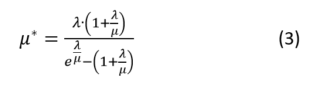
μ* represents the inverse mean downtime when a pump failure occurs. Next, define the pump replacement time t, then the new Availability A* is:
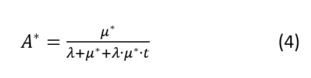
The coefficient of t in Eq. 4 depends on details of the pump replacement and the resulting elaborated Markov Chain process. Eq. 4 shows the expected availability of the pump system depending on the pump replacement time. t is usually larger for the spare part case compared with the standby case due to the transportation, removal, and assembly times. Therefore, it is better to use a standby pump. However, there is another element which was not considered so far: cost.
Which one costs less?
It depends on what downtime costs. Standby adds parallel piping, power supplies and floor space; a spare adds storage and packaging. Where downtime is very expensive, standby tends to win.
A high cost is usually incurred per hour of system downtime. The total downtime during the life cycle is:

where tdown is the down time and tlife is the lifecycle period. Other cost factors for the standby scenario are due to demand for parallel piping, power supplies, and increased floor space; while the spare part scenario requires storage and packaging expenses.
When downtime is very costly, a standby solution is usually preferred. Indeed, in many oil refineries, remote water supply stations, and critical systems a standby design is used.
The advantage of using spare pumps instead of standby units becomes apparent when many identical systems use a shared stock. Then fewer pump units have to be purchased. This gives a substantial financial saving.
How does this scale to a line of pumps?
On a line of 10 pumps in series, the choice becomes a standby unit for each pump or a small shared pool of spares — and the two no longer cost anything like the same.
Consider a line with 10 pumps in series. To maintain a high availability, two possibilities are considered:
How does the standby arrangement behave?
The backup sits idle in cold standby and takes over the moment the operating pump fails, while the failed pump goes for hot repair; the system only fails if the backup fails before that repair completes.
Assume that a standby pump was added for each pump (having a total of 20 pumps). Furthermore, assume that upon failure the pump switching time is negligible.
The main costs are: single pump cost of 500,000$, single pump repair cost of 5,000$, and downtime damage of 20,000$ per hour. The total cost for a lifecycle of 20 years was calculated using the apmOptimizer software to be: 11,373,720$ with a line availability of 99.979%.
And what does a shared spares pool cost?
Twelve pumps in total — two spares in storage shared across the line, with a 2-hour switching time — priced on the same pump, repair and downtime figures over the same 20-year lifecycle.
Instead of the 10 standby pumps, 2 spare pumps are put in storage (total of 12 pumps). The stock of two spare pumps is shared by all the pumps in the field. The pump switching time is assumed to be 2 hours.
The main costs are: single pump cost of 500,000$, single pump repair cost of 5,000$, and downtime damage of 20,000$ per hour. The total cost for a lifecycle of 20 years was calculated using the apmOptimizer software to be: 8,997,945$ with an availability of 99.924%.
So which design wins?
Standby gives higher availability, but it costs more than $2,375,000 more over the lifecycle to get it. For the spares design the optimal pool is 2: fewer carries a heavy availability penalty, and 3 or more adds almost nothing.
The standby design gives higher availability compared to the design of the spare, however, the lifecycle cost of achieving this availability is higher than the spare design by more than 2,375,000$. The optimal number of spares for the spares scenario is 2, fewer spares incur a high penalty due to low availability while adding additional spares (3 or more) gives negligible availability improvement.
What is the general lesson?
Redundancy design usually belongs to the reliability engineer and maintenance policy to the maintenance engineer, and this example is what happens when the two are decided separately — both need to be considered as early as possible.
In this paper, we discussed the similarities and differences between using standby units and having spare units. This is an example of the connection that exists between redundancy design which is usually the job of the reliability engineer, and maintenance policy which is classically set by the maintenance engineer.
The examples above demonstrate the need for both reliability and maintenance to be considered as early as the asset design stage.