
Naval vessels are complex platforms that combine highly advanced telecommunications, radar, defensive, and offensive technologies, as well as high-power propulsion systems. The goal of a vessel is to provide high mission reliability, i.e., a high probability of mission success.Naval missions have unique characteristics:
- Long mission durations
- Low or no access to spare parts other than COB (Carry On Board)
- Harsh conditions
Several system design methods exist for achieving high mission reliability:
- High reliability of each piece of equipment
- Hot redundancy
- Spare parts
High equipment reliability is always preferred because it reduces the need for redundant or spare units. However, most equipment is procured from third-party vendors, and it is not always possible to obtain equipment with the desired reliability.
What is reliability allocation, and when do you do it?
Reliability allocation is the initial-design step that identifies which equipment needs redundancy or spare parts, and it produces the realistic MTBF requirements you give to OEMs so the system is expected to meet its mission reliability requirement.
During initial system design, a process of reliability allocation should be conducted to identify equipment that requires redundancy or spare parts. Reliability allocation allows you to design effective systems with the right number of redundancies and provide realistic MTBF (Mean Time Between Failure) requirements to OEMs, ensuring that the system is expected to comply with the mission reliability requirement.
What is reliability prediction for?
Reliability prediction is the detailed-design analysis that verifies the design actually complies with the required mission reliability, rather than assuming the allocation held.
During detailed design, an accurate reliability analysis should be conducted to verify compliance with the required mission reliability.
Why must naval spare parts be planned during early design?
Because carried-on-board spares are limited by weight and cost and they materially affect mission reliability, so unlike most industries the redundancy and sparing decisions cannot wait until late design.
In many industries, spare parts analysis is conducted late in the design process. However, this is not the case when designing naval systems because COB spare parts are limited by weight and cost, and they significantly affect mission reliability. Therefore, redundancies and spare parts must be considered from the early stages of design.
What does this look like on a real communication system?
With no redundancy and no spares, the allocation for this communication system demands an MTBF of 855,310 hours from the transceivers and end units — too strict for either, which is what forces spare parts into the design and makes them modellable as standby items in RBD.
Consider the case of a communication system with the following requirements:
- 2 transceivers must be operational
- 10 end units must be operational
- Mission reliability requirement is 98% for a mission duration of 60 days
Reliability allocation with no redundancies and no spare parts provides an MTBF requirement for the transceivers and end units of 855,310 hours.
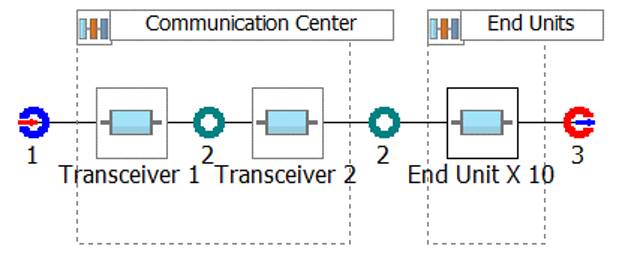
The MTBF requirement is too strict for both the transceivers and end units. Therefore, spare parts must be added. Spare parts can be modeled in RBD software using standby models. By adding 2 spare end units and 1 spare transceiver, the MTBF requirement is reduced to 28,352 hours.
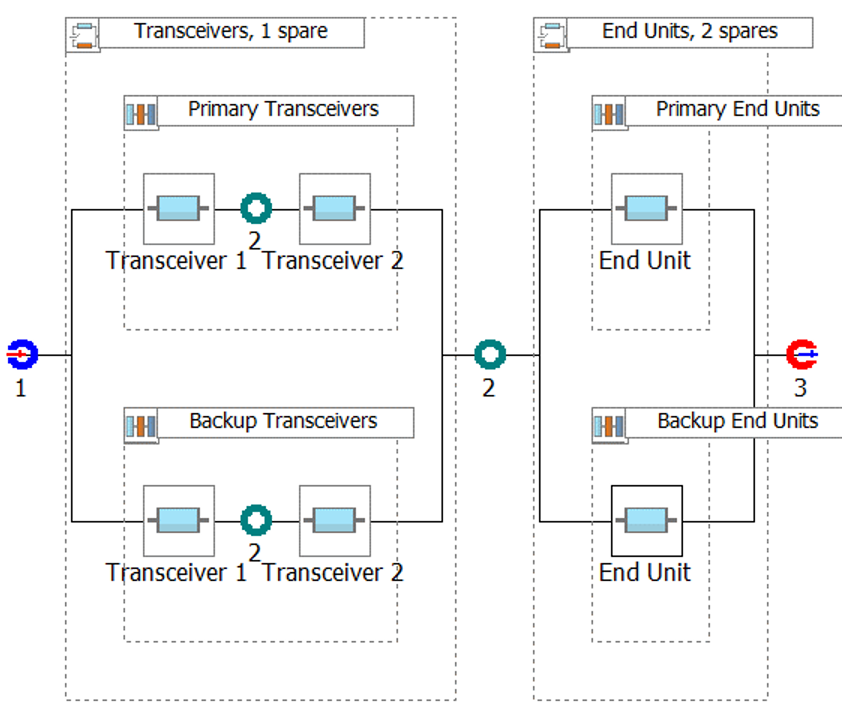
This MTBF requirement is much more realistic. Next, an MTBF of 40,000 hours was provided by the OEM for the transceivers. This value can be fixed, and then the end units' minimal MTBF requirement is reduced slightly to 26,841 hours.
Finally, an MTBF of 30,000 hours was provided for the end units by the OEM. With this, the mission reliability is calculated to be 98.46%.
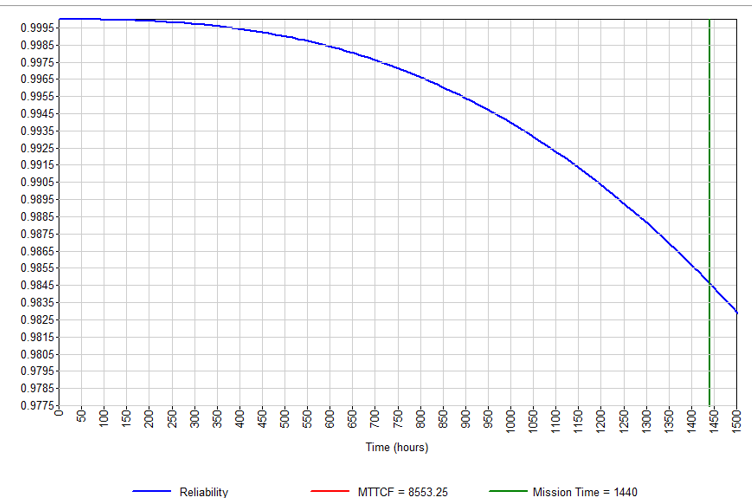
This simple example shows how reliability allocation and calculation can be used to optimize the system design and ensure compliance with performance requirements.
CARE® is BQR's automated RAMS (Reliability, Availability, Maintainability, and Safety) analysis tool for system design. It incorporates Markov Chain models for load sharing and other multi-state models, as well as RBD (Reliability Block Diagram) network models for communication and utility networks.
To learn more about how CARE® can optimize your system design, contact us or request a demo today.